

1. Introduction: A New Architecture for Global Finance
The tokenization of Real-World Assets (RWA) is not merely an incremental technological advancement; it represents a fundamental re-architecture of global finance. This process, which transforms rights to tangible and financial assets into programmable digital tokens on a blockchain, has moved decisively from a conceptual phase to a multi-billion-dollar reality. By unlocking unprecedented liquidity, efficiency, and accessibility for assets ranging from private credit to real estate, RWA tokenization is laying the groundwork for a more interconnected and efficient global market.
The institutional significance of this trend is profound, a sentiment echoed by leaders at the highest levels of the financial industry.
"The next generation for markets, the next generation for securities, will be tokenization of securities."
— LARRY FINK, CEO & CHAIRMAN, BLACKROCK
This primer provides a comprehensive analysis of the RWA market to enable strategic decision-making. It examines key market data, evaluates the leading asset classes driving growth, maps the evolving global regulatory landscape, and identifies the core ecosystem of players and technologies. The analysis concludes with a forward-looking view of the strategic opportunities, challenges, and technological convergences that will define the market's future.
2. What is RWA Tokenization?
Tokenization is the process of transforming rights to a real-world asset—one backed by physical assets or legal contracts, such as real estate or bonds—into a digital token on a blockchain. This token represents ownership or a claim over the underlying asset. The key innovation is that it enables assets that were once illiquid or restricted by geography to be fractionalized, transferred, and traded globally, 24/7. Tokenized assets can be classified into different categories based on how deeply they are integrated with the blockchain.
- Onchain Native Tokens (e.g., MakerDAO’s DAI Savings Rate (DSR) / sDAI): The blockchain acts as the definitive ledger. Investors can seamlessly invest, trade, and receive distributions entirely onchain.
- Onchain Represented Tokens (e.g., Franklin Templeton’s FOBXX on Stellar): Ownership is recorded onchain, but key interactions such as investing and payout distributions occur offchain through traditional financial processes.
- Digital Twin (Reference) Tokens (e.g., Synthetix sBTC, sGold, sTSLA): These tokens simply mirror an offchain asset; the blockchain only mirrors the asset's data, but isn't the official record of ownership. This process can be applied to a vast and diverse range of assets, bridging the gap between traditional finance and the digital world.
3. How Does the Tokenization Process Work?
A Real Estate Example: To make the concept tangible, let's explore a simplified, real-world example of how a company might tokenize a €1 million rental property.
- Legal & Structural Setup: The company first creates a dedicated legal entity, like a Special Purpose Vehicle (SPV), to hold the property. This legally isolates the asset, protecting investors from risks related to the tokenization company itself. The company then gets a professional appraisal to confirm the property's value.
- Token Creation (Minting): The company creates, or "mints," 1,000 digital tokens on a blockchain like Ethereum. Each token is programmed to represent a €1,000 share of the property's value.
- Primary Market Sale: Investors purchase these tokens directly from the company in an initial offering. For example, an investor could buy 100 tokens for €100,000, giving them a 10% stake in the property.
- Secondary Market Trading: After the initial sale, the investor can sell some or all of their tokens to other people on a secondary marketplace, providing liquidity without having to sell the entire property.
- Automated Income Distribution: If the property generates €50,000 per year in rental income, that income is automatically distributed to the token holders. Each of the 1,000 tokens would earn €50 in income, paid out efficiently via the blockchain.
- Use as Collateral: The tokens, representing a real asset, can also be used as collateral to take out loans within the decentralized finance (DeFi) ecosystem. This example illustrates the practical steps, but the true power of tokenization lies in the strategic advantages it offers over traditional financial systems.
4. The RWA Market Landscape: A Quantitative Snapshot
Analyzing the current market metrics is of critical strategic importance. These figures confirm that RWA tokenization has transitioned from an experimental technology to a scalable industry with significant institutional adoption. This quantitative snapshot provides a baseline for strategic decision-making by illustrating the current scale and projected trajectory of this transformative market.
4.1 Key RWA Market Metrics
Metric |
Value / Projection |
|---|---|
Total Tokenized RWA Market Value (as of Nov 2025) |
$35.96 Billion |
Market Growth Since 2022 |
719% (from $5 Billion) |
Projected Market Size by 2030 (McKinsey) |
$2–4 Trillion |
Long-Range Market Projection by 2033 (Ripple/BCG) |
$18 Trillion |
4.2 Top Asset Classes by Market Value
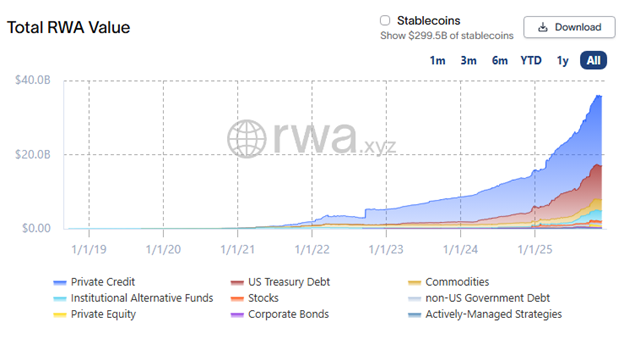
The market's value is highly concentrated in a few key asset classes that have proven to be ideal initial candidates for tokenization:
· Private Credit: $18.9 Billion
· U.S. Treasuries: $9.1 Billion
· Commodities: $3.0 Billion
4.3 Leading Tokenized Products by Assets Under Management (AUM)
Several specific products have achieved significant scale, signaling strong demand from both institutional and individual investors:
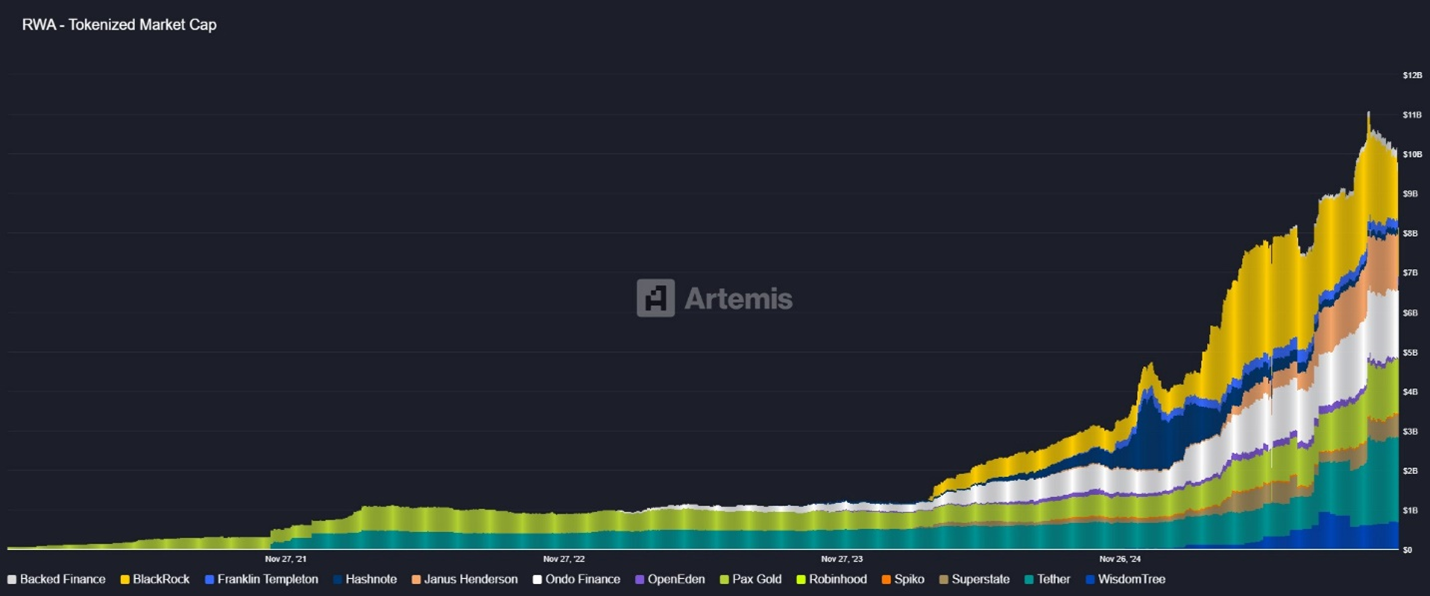
· BlackRock BUIDL: $2.3 Billion
· Paxos Gold PAXG: $1.4 Billion
· Tether Gold XAUT: $1.6 Billion
· WisdomTree Govt. Money Market Digital Fund (WTGXX): $660 Million
· Janus Henderson Anemoy AAA CLO Fund (JAAA): $1.0 Billion
These high-level numbers set the stage for a deeper analysis of the specific asset classes driving this growth, each fulfilling a distinct strategic purpose within the emerging on-chain financial system.
5. Deep Dive: Analysis of Leading RWA Asset Classes
The strategic value of tokenization becomes most apparent when examining the unique drivers and innovations within each major asset class. Different assets serve distinct institutional purposes—from low-risk on-ramps like U.S. Treasuries to high-yield, liquidity-solving instruments like private credit. Understanding these nuances is crucial for identifying market opportunities.
5.1 U.S. Treasuries: The Institutional On-Ramp
Tokenized U.S. Treasuries have emerged as the ideal institutional on-ramp to digital assets. Their core characteristics—ultra-low risk, predictable returns, and the full backing of the U.S. government—make them a perfect vehicle for corporations and asset managers to deploy on-chain liquidity and manage treasury operations with confidence.
Dominant players in this segment include major financial institutions such as BlackRock, Franklin Templeton, and fintech innovator Ondo Finance. Their products typically operate under one of two primary models:
- Yield-bearing tokens: These tokens, like Ondo’s USDY, appreciate in value over time to reflect the accrued interest on the underlying Treasury securities.
- Rebasing tokens: This model, used by products like BlackRock's BUIDL, distributes yield to holders through the periodic issuance of new tokens directly into their wallets.
5.2 Private Credit: Unlocking Liquidity in a High-Yield Market
By market value, private credit is the largest tokenized RWA segment. Its appeal is twofold. First, it offers investors access to attractive high-yield premiums, typically between 8-12%, that are uncorrelated to public markets. Second, tokenization directly solves the asset's primary friction point: illiquidity. By converting private loans into tradable digital assets, issuers offer enhanced liquidity without compromising institutional-grade underwriting standards.
The leading player in this space is Figure, which has originated over $16.2 billion in loans, with more than $12.38 billion currently active on the purpose-built Provenance Blockchain. Furthermore, integrations with DeFi are amplifying returns. For instance, Apollo's ACRED fund is being used in leverage loops on platforms like Morpho and Kamino, demonstrating how on-chain assets can be composed to create efficiencies impossible in traditional finance.
5.3 Equity: The Next Frontier of On-Chain Value
Tokenized equity is widely considered a "breakthrough" category with the potential to become the dominant RWA class. However, it is critical to distinguish between native on-chain equity and synthetic wrappers. For instance, companies like Caesar and Galaxy are issuing true legal shares on-chain, whereas Robinhood's offering for European users explicitly provides derivative contracts that only grant price exposure to U.S. stocks. The former represents actual legal ownership, while the latter only provides price exposure.
"Many so-called onchain equities in the market aren’t equity at all. They’re derivatives that only give you price exposure to an underlying asset. You don’t have voting rights, you don’t have dividend rights, and you have no real claim against the issuer if something goes wrong."
— Eli Cohen, Chief Legal Officer, Centrifuge Labs
For companies that issue true on-chain equity, the benefits are significant:
- Operational Upgrade: Tokenization replaces antiquated paper certificates and spreadsheets with an automated, auditable, and transparent blockchain-based registry for managing investors.
- New Distribution Channels: It provides access to a global base of new investors, unlocking previously closed segments of the private markets for capital formation.
However, significant infrastructure gaps must be addressed to enable widespread adoption, including the need for regulated secondary markets for liquidity and wallet-based Know Your Customer (KYC) solutions for compliance. The friction between new technology and legacy systems is also apparent, with Nasdaq planning to use a T+1 settlement cycle for tokenized shares, which falls short of the instant (T+0) finality native to blockchain.
5.4 Real Estate and Commodities: Digitizing Tangible Value
The digitization of tangible assets continues to gain momentum. The tokenized real estate market is projected to reach a $1.4 trillion market cap by 2026, with government-backed initiatives providing a clear blueprint for success. A prime example is the Dubai Land Department (DLD) program, which issues official Property Token Ownership Certificates on a public blockchain, demonstrating a scalable and legally recognized model.
In commodities, the market has surpassed $2.0 billion in value and is currently dominated by gold-backed tokens. Leading products such as Paxos Gold (PAXG) and Tether Gold (XAUT), each backed 1:1 by physical, vaulted bullion, account for the majority of this activity.
The growth across these asset classes ultimately depends on the global regulatory environment that governs them.
6. The Global Regulatory Landscape: Mapping the Path to Compliance
Regulatory clarity is the single most critical catalyst for the institutional adoption of RWA tokenization. A predictable legal framework provides the confidence for asset managers, banks, and investors to deploy capital at scale. While a harmonized global rulebook has yet to emerge, a fragmented but increasingly clear multi-jurisdictional map is providing the guardrails for compliant innovation.
Europe: Leadership Through Hard-Law Clarity
Europe has positioned itself as the "rulebook leader" by establishing comprehensive, hard-law frameworks. The Markets in Crypto-Assets (MiCA) regulation provides a passportable licensing regime across the EU. This is complemented by the DLT Pilot Regime, a sandbox for tokenized securities, while Switzerland (FINMA-supervised venues) and the UK (Digital Securities Sandbox) are advancing on mature, parallel paths.
United States: Scaling Under Existing Frameworks
The U.S. is pursuing a technology-neutral, "same activity, same rules" approach, applying existing securities laws to digital assets. This strategy relies on rigorous oversight from federal regulators. A key milestone is Nasdaq's formal filing to trade tokenized securities, a significant step toward integrating RWAs within the established national market system.
Asia-Pacific: Supervisor-Orchestrated Innovation
The APAC region has adopted a model of "supervisor-orchestrated pilots with selective retail access." Financial hubs are actively steering innovation through structured programs, including Singapore's Project Guardian, Hong Kong's comprehensive stablecoin regime, and Japan's deepening framework for security tokens.
The Gulf, Latin America, and Africa: Pragmatic and Pro-Innovation Frameworks
These regions are characterized by pragmatic, pro-innovation postures. The UAE leads with dedicated licensing bodies like VARA (Dubai) and ADGM (Abu Dhabi). Meanwhile, countries like Brazil and South Africa are pursuing use-case-driven routes under existing laws, enabling tokenized finance under clear domestic guardrails.
This global regulatory progress relies on a robust ecosystem of technology providers, platforms, and financial institutions working in concert.
7. The RWA Ecosystem: Infrastructure and Key Players
A sophisticated, multi-chain ecosystem of issuers, platforms, and technologies underpins the RWA market's growth. This network provides the essential rails for creating, managing, and distributing tokenized assets in a compliant and secure manner.
Ecosystem Layer |
Representative Players / Technologies |
|---|---|
Issuers & Asset Managers |
BlackRock, Franklin Templeton, Janus Henderson, Siemens, Hamilton Lane, Figure, Société Générale |
Tokenization Platforms |
Centrifuge, Securitize, Tokeny, Dinari, Mavryk Network |
Dominant Blockchain Networks |
Ethereum, Avalanche, ZKsync Era, Stellar, Aptos, Solana |
Data & Infrastructure |
Chainlink, RWA.xyz, Oracles, Secure Custody Frameworks |
Key Token Standards |
ERC-3643 (compliance), ERC-20, ERC-721/1155 |
A notable trend is the rise of Purpose-Built and Corporate Blockchains. This signals a strategic shift toward specialized infrastructure designed for regulated finance. Examples include institution-specific networks like Provenance Blockchain and Polymesh, alongside corporate-led initiatives such as J.P. Morgan’s Onyx and Goldman Sachs’ GS DAP™. This bifurcation suggests a "multi-rail" future where the asset type and use case dictate the underlying blockchain.
The intricate and multi-layered nature of this ecosystem directly shapes the strategic opportunities and operational challenges that institutions must navigate to succeed.
8. Strategic Implications: Opportunities and Challenges
For business leaders, understanding the core benefits and persistent hurdles of RWA tokenization is essential for developing effective strategies and managing risk. This section distills the primary opportunities unlocked by the technology and the headwinds that continue to shape its trajectory.
Core Opportunities of RWA Tokenization
- Liquidity Transformation: Unlocks capital from traditionally illiquid assets like private equity and real estate, fundamentally altering their capital efficiency and creating dynamic, tradable instruments from static balance sheet items.
- Global Accessibility: Removes geographic barriers to create global, 24/7 markets, broadening investor pools for capital formation and dramatically reducing distribution costs.
- Instant Settlement: Reduces counterparty risk and frees up trapped capital by moving from inefficient T+1/T+2 settlement cycles to near-instantaneous (T+0) transactions, enhancing market velocity.
- Programmable Compliance: Automates complex regulatory processes like KYC/AML checks, investor accreditation, dividend payments, and reporting directly into the asset, significantly lowering operational costs and human error.
- Enhanced Transparency: Provides a clear, immutable, and real-time record of ownership and transactions on a distributed ledger, simplifying audits, increasing investor trust, and reducing fraud.
Persistent Challenges and Headwinds
- Regulatory Fragmentation: Navigating diverse and evolving legal frameworks across jurisdictions remains a primary operational challenge, complicating cross-border compliance and requiring sophisticated issuance strategies.
- Secondary Market Liquidity: The absence of deep, regulated secondary markets for most RWAs remains the primary bottleneck to mainstream adoption, trapping value in assets that have been tokenized but cannot yet be efficiently traded at scale.
- Legal Enforceability: Uncertainty persists regarding the full legal recognition and enforceability of on-chain ownership rights across all judicial systems, creating a need for legal precedent to solidify investor protections and attract conservative capital.
- Custodial Complexity: Securely managing cryptographic keys and digital wallets presents new technical and counterparty risks that demand robust, institutional-grade solutions, a segment of the market that is still maturing.
The convergence of emerging technologies is poised to address these challenges and unlock the next phase of growth.
9. Future Outlook: The Dawn of the Convergence Era
The future of tokenization lies at the intersection of RWAs with Onchain AI, Verifiable Digital Identity, and Composable Finance. This "Convergence Era" will create self-optimizing, interoperable, and globally accessible financial ecosystems that are more intelligent, efficient, and compliant than today's systems.
The three pillars of this new era are:
- Onchain AI Agents as Autonomous Portfolio Architects AI-driven agents will autonomously manage complex tasks like asset rebalancing, risk assessment, and governance participation, creating self-optimizing financial ecosystems with reduced friction.
- Verifiable Digital Identity Unlocks Global Capital Flow Seamless, on-chain KYC and verifiable credentials will dissolve cross-border barriers, enabling truly compliant and frictionless access to global capital markets.
- Composable Finance Drives New Market Synergies RWAs will become fully interoperable with DeFi primitives like automated market makers and flash loans, unlocking unprecedented liquidity and innovative hybrid financial products.
The Convergence Era marks the maturation of RWA tokenization into the foundational architecture for the next generation of finance. For institutions, investors, and innovators, the message is clear: the time to move from blueprint to pilot is now. Leaders who grasp this will not only compete but will define the future of the market.
About the Authors
Martin Leinweber
Martin Leinweber works as the Director of Digital Asset Research and Strategy at MarketVector providing thought leadership in an emerging asset class. His role encompasses product development, research, and communication with the client base of MarketVector. Before joining MarketVector, he worked as a Portfolio Manager for equities, fixed-income, and alternative investments for almost 20 years. Martin was responsible for the management of active funds for institutional investors such as insurance companies, pension funds, and sovereign wealth funds at the leading German quantitative asset manager Quoniam. Previously, he held various positions at one of Germany's largest asset managers, MEAG, the asset manager of Munich Re and ERGO. Among other things, he contributed his expertise and international experience to the establishment of a joint venture with the largest Chinese insurance company PICC in Shanghai and Beijing. Martin is co-author of “Asset-Allokation mit Kryptoassets. Das Handbuch “(Wiley Finance, 2021). It’s the first handbook about integrating digital assets into traditional portfolios. He has a Master of Economics from the University of Hohenheim and is a CFA Charter holder.
Jonas Weber
Jonas Weber is an emerging expert in digital assets and investment strategies. As a Digital Asset Analyst at MarketVector, he excels in generating innovative index ideas, conducting in-depth research, and supporting client communications. Before joining MarketVector, Jonas honed his skills as a working student in Investment Consulting. At Lurse AG, a pension consultancy firm, he was instrumental in developing new investment strategies and analyzing the risk and performance of model portfolios. His collaboration with Lurse AG also extended to his master’s thesis, which he completed summa cum laude, focusing on various investment strategies and deriving optimal guarantee levels.
Important Disclosure
These materials have been prepared solely for informational purposes based upon information generally available to the public from sources believed to be reliable. No content contained in these materials (including index data, ratings, credit-related analyses and data, model, software, or other application or output therefrom) or any part thereof (Content) may be modified, reverse-engineered, reproduced or distributed in any form by any means, or stored in a database or retrieval system, without the prior written permission of MarketVector. The Content shall not be used for any unlawful or unauthorized purposes. MarketVector and its third-party data providers and licensors (collectively “MarketVector Parties”) do not guarantee the accuracy, completeness, timeliness, or availability of the Content. MarketVector Parties are not responsible for any errors or omissions, regardless of the cause, for the results obtained from the use of the Content. THE CONTENT IS PROVIDED ON AN “AS IS” BASIS. MARKETVECTOR PARTIES DISCLAIM ANY AND ALL EXPRESS OR IMPLIED WARRANTIES, INCLUDING, BUT NOT LIMITED TO, ANY WARRANTIES OF MERCHANTABILITY OR FITNESS FOR A PARTICULAR PURPOSE OR USE, FREEDOM FROM BUGS, SOFTWARE ERRORS, OR DEFECTS, THAT THE CONTENT’S FUNCTIONING WILL BE UNINTERRUPTED OR THAT THE CONTENT WILL OPERATE WITH ANY SOFTWARE OR HARDWARE CONFIGURATION. In no event shall MarketVector Parties be liable to any party for any direct, indirect, incidental, exemplary, compensatory, punitive, special, or consequential damages, costs, expenses, legal fees, or losses (including, without limitation, lost income or lost profits and opportunity costs) in connection with any use of the Content even if advised of the possibility of such damages.
Get the latest news & insights from MarketVector
Get the newsletterRelated:
Most popular
-
 Commentary
Hidden GEMs: Algeria
-
 Commentary
MVGMMA Index Reduces Equity Exposure
-
 Commentary
Hidden GEMs: Venezuela