
Sri Lanka may be famed for its tea, beaches, and heritage, but the country’s financial markets are increasingly drawing the attention of global investors. The Colombo Stock Exchange (CSE), while modest in size, offers concentrated and liquid exposure to some of the country’s most established corporate leaders, including diversified conglomerates, leading banks, telecom operators, and consumer-facing businesses. With nearly 300 listed companies and a core group of blue-chip names dominating market capitalization and turnover, the CSE provides targeted access to Sri Lanka’s economic backbone. As macroeconomic stability returns, reforms advance, and external buffers strengthen, the market is transitioning from crisis recovery toward a more normalized growth environment positioning Sri Lanka as an increasingly compelling frontier-market allocation within global portfolios.
Rebuilding After the Crisis
Sri Lanka faced a severe economic crisis in 2022, culminating in a sovereign debt default in April 2022 after foreign exchange reserves were depleted and external financing pressures intensified. The country subsequently entered an IMF Extended Fund Facility (EFF) program in March 2023, initiating fiscal consolidation, monetary tightening, and structural reforms to restore stability.
Since then, macroeconomic conditions have improved meaningfully. Real GDP grew by approximately 5.0% in 2024, inflation has moderated sharply from crisis highs, and gross official reserves have rebuilt to around USD 6–7 billion. While part of the recent equity market strength reflects a rebound from distressed levels, it also signals improving fundamentals and renewed investor confidence.[1]
Sri Lanka’s Macro Snapshot: Growth, Investment & Markets
- GDP Growth (2024): Sri Lanka’s economy has made a remarkable recovery in 2024, surpassing growth expectations by recording 5 percent growth marking a strong recovery following the 2022–2023 crisis period, compared to the projected 4.4 percent, says the World Bank.[2]
- Gross Official Reserves (December 2025): Sri Lanka’s gross official reserves stood at approximately USD 6.8 billion as of December 2025, reflecting a continued rebuilding of external buffers under the IMF-supported stabilization program.[3]
- Investment Proposals / FDI (June 2025): The Government reported a continued rise in investment momentum in 2025, with total investment proposals around ~US$ 4,669 million by mid-year, inclusive of both foreign and local commitments as companies sign new projects.[4]
- Realized FDI Q1 2025: The Board of Investment of Sri Lanka (BOI) reported that FDI inflows reached ~USD 1,057 million, up 72 % vs. 2024 marking meaningful recovery in capital flows.[5]
- Equity Market Performance (12-month): Sri Lanka’s main stock market benchmark, the Colombo Stock Exchange All Share Price Index (ASPI), stood around ~23,750–23,800 points in late February 2026, and was ~44 % higher over the past 12 months.[6]
Colombo Stock Exchange: Structure & Dynamics
The Colombo Stock Exchange (CSE) is Sri Lanka’s primary securities market, listing equities, debt instruments, and derivatives. Its main indices are:
- All Share Price Index (ASPI) – reflects overall market performance.
- S&P Sri Lanka 20 (S&P SL20) – tracks the 20 largest and most liquid stocks.
The CSE has nearly 300 listed companies, but trading activity is concentrated in a few blue-chip firms. Top traded stocks include John Keells Holdings (JKH), Commercial Bank of Ceylon (COMB), and Dialog Axiata (DIAL).
Hidden Gems: Stocks & Sectors to Watch
While a few blue-chip companies dominate the Colombo Stock Exchange (CSE), several stocks and sectors are worth keeping an eye on:
Top Stocks:
John Keells Holdings PLC (JKH) – diversified conglomerate
- Commercial Bank of Ceylon PLC (COMB) – leading bank
- Sampath Bank PLC (SAMP) – strong retail & corporate banking
- Hatton National Bank PLC (HNB) – extensive branch network
Sectors to Watch:
Renewable energy, Tourism, hospitality, and real estate
These companies and sectors are driving market activity and could offer growth opportunities beyond the most liquid blue-chip stocks.
Why It’s Still a Hidden Gem
Sri Lanka’s equity market remains a hidden gem, offering attractive opportunities for investors. Stocks are currently undervalued compared with regional peers, providing potential upside for early entrants. Structural tailwinds in sectors like tourism, IT, renewable energy, and apparel, combined with IMF-backed reforms and regulatory modernization, are enhancing market stability. As the economy and equity market rebound, early investors could benefit from medium to long-term growth fueled by policy momentum and ongoing reforms.
Sri Lanka in the MarketVector™ Total Global Equity Index (MVTGLE)
As of Q1 2026, four Sri Lanka–listed blue-chip firms, John Keells Holdings, Commercial Bank of Ceylon, Sampath Bank, and Hatton National Bank make up the country’s presence in the MarketVector™ Total Global Equity Index (MVTGLE)7.
2-Year USD Performance of Sri Lanka Constituents in MVTGLE
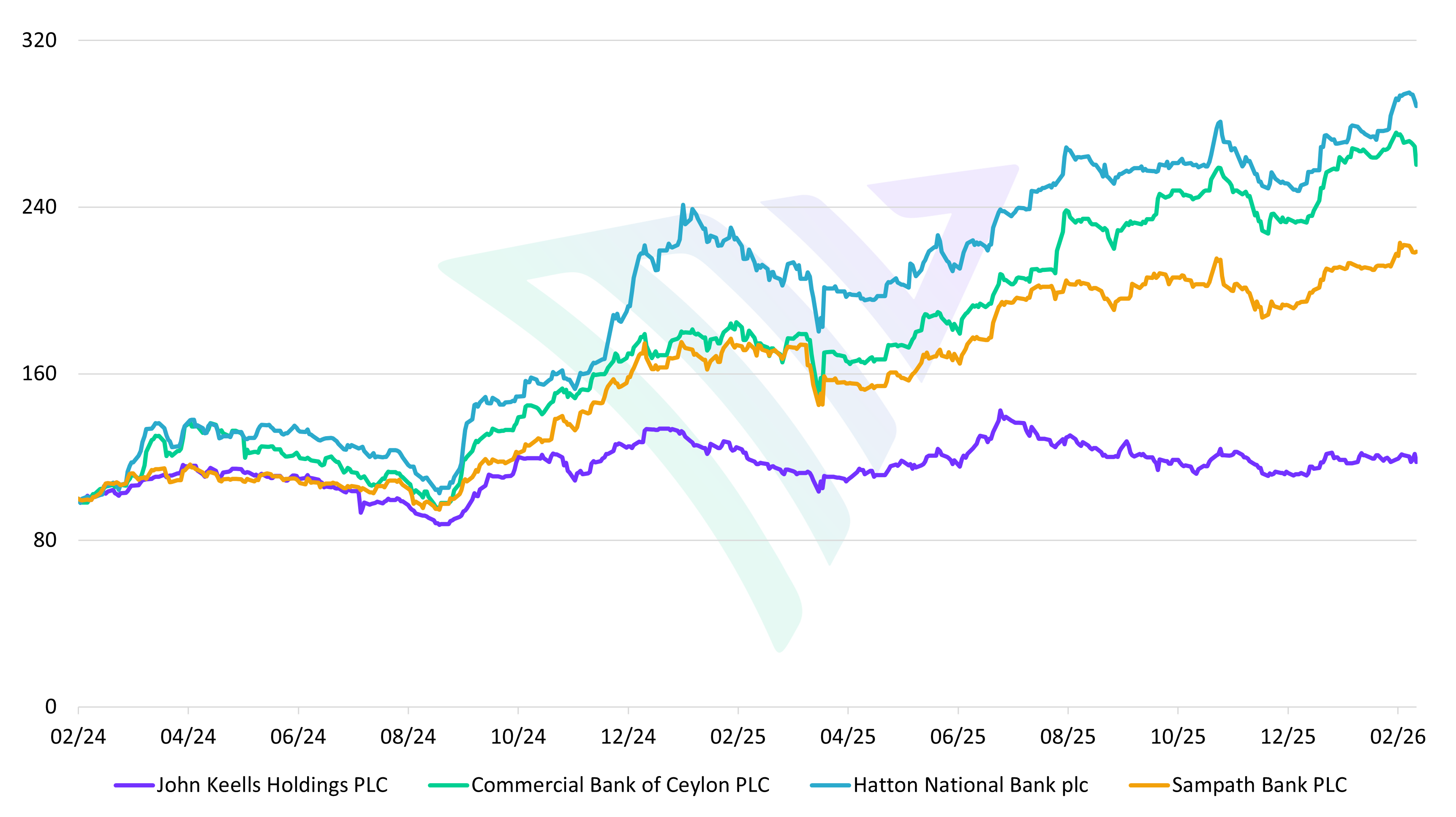
Source: FactSet; Colombo Stock Exchange. Data as of February 28, 2026. Returns calculated in USD terms.
Sri Lanka’s representation in the index expanded in Q2 2025, when Commercial Bank of Ceylon, Hatton National Bank, and Sampath Bank were added alongside John Keells Holdings. In 2025Q3, these four companies dominate the Sri Lanka slice, which currently accounts for 0.28% of the global index, yet provides investors with efficient and liquid access to the country’s largest blue-chip companies.
Because the slice is concentrated in these top CSE-listed firms, its performance closely tracks the All Share Price Index (ASPI) locally, allowing global investors to gain exposure to Sri Lanka’s equity market without trading directly on the CSE.
In short, Sri Lanka’s inclusion in MVTGLE offers targeted exposure to one of Asia’s smaller but promising emerging markets, making it an attractive option for international investors seeking growth opportunities.
Conclusion
The Colombo Stock Exchange, while small and still developing, could offer the potential for outsized returns. Supported by its strategic location, improving macroeconomic fundamentals, and ongoing reform momentum, Sri Lanka’s equity market could emerge as one of Asia’s most compelling hidden gems over the next decade. For global investors, inclusion within a diversified global equity index framework allows Sri Lanka exposure to be accessed passively, reducing single-market operational complexities while maintaining participation in the country’s recovery trajectory.
[2] GDP growth (annual %) - Sri Lanka | Data
[3] press_20260227_external_sector_performance_january_2026_e.pdf
[4] Foreign Direct Investment records 90% Increase in First Quarter of 2025 - President's Office | President's Office
[6] Sri Lanka Stock Market (CSE All Share) - Quote - Chart - Historical Data - News | Trading Economics
[7]MarketVector™ Total Global Equity Index | MVTGLE
About the Author(s):
Shubhangi Rajvanshi joined MarketVector Indexes™ in 2021, beginning her role in Index Operations and currently serving as a Data Manager, specializing in data validation, vendor reconciliation, database management, fundamentals screening, and automation of index processes. She has over 4.5 years of prior experience in developing administration and calculation of indices. She holds a master’s degree in finance from ICFAI Business School, Gurgaon, India and brings strong analytical and technical skills to index and data management processes.
For informational and advertising purposes only. The views and opinions expressed are those of the authors but not necessarily those of MarketVector Indexes GmbH. Opinions are current as of the publication date and are subject to change with market conditions. Certain statements contained herein may constitute projections, forecasts, and other forward-looking statements that do not reflect actual results. It is not possible to invest directly in an index. Exposure to an asset class represented by an index is available through investable instruments based on that index. MarketVector Indexes GmbH does not sponsor, endorse, sell, promote, or manage any investment fund or other investment vehicle that is offered by third parties and that seeks to provide an investment return based on the performance of any index. The inclusion of a security within an index is not a recommendation by MarketVector Indexes GmbH to buy, sell, or hold such security, nor is it considered to be investment advice.
Get the latest news & insights from MarketVector
Get the newsletterRelated:
Most popular
-
 Commentary
Goal! Small Country, Big Impact
-
 Commentary
Hidden GEMs: Ukraine