
Market Structure and Benchmark Integrity
In U.S. rates markets, the concept of a “benchmark” is not abstract, it is explicit, observable, and universally agreed upon. At every point along the yield curve, market participants reference a single, most recently issued Treasury security, commonly referred to as the on-the-run bond1.
These securities are not merely indicative; they are the instruments through which price discovery occurs. They concentrate liquidity, anchor repo and funding markets, and serve as the primary reference for futures, swaps, and relative value trading2. When market participants refer to “the 2-year” or “the 10-year,” they are not referencing a basket or an average, they are referencing a specific CUSIP.
A true benchmark must reflect how the market actually trades. Any deviation from the on-the-run convention therefore results in an approximation, rather than a true representation of the market’s pricing mechanism.
This alignment is particularly relevant in the current macro environment, where shifting monetary policy, evolving central bank leadership, and geopolitical uncertainty are contributing to elevated volatility in U.S. Treasury markets. In such conditions, precise and transparent benchmark exposure becomes increasingly important for pricing, hedging, and risk transfer.
The Structural Limitation of Traditional Bond Indexes
Most conventional Treasury indexes diverge from this principle. By construction, they:
- Hold multiple securities per maturity segment
- Apply weighting schemes based on market value or duration
- Introduce mechanical rebalancing and turnover rules
While such approaches may be suitable for broad portfolio representation, they introduce structural distortions when used as benchmarks for trading or derivatives.
First, basket construction dilutes benchmark purity by averaging across multiple securities, resulting in exposure that does not correspond to any tradable instrument.
Second, duration smoothing obscures true rate sensitivity. Market participants hedge using the precise duration of on-the-run instruments, whereas basket-based indexes embed shifting duration profiles driven by composition rather than market convention.
Third, such indexes introduce implicit optionality and basis noise, as multiple securities create discrepancies between index exposure and tradable instruments, complicating hedging, pricing, and arbitrage.
As a result, these traditional benchmarks function as statistical aggregates, not as true market benchmarks.
From Market Convention to True-Representative Benchmarks
The defining innovation of the MarketVector™ U.S. Treasury On-the-Run Indexes is the strict alignment with market convention as the primary source of truth.
Each index systematically selects and tracks the single most recently issued U.S. Treasury security within a defined maturity bucket3.
This design ensures that each index is:
- Directly anchored to the instrument used in real-world trading
- Fully aligned with dealer quoting conventions
- Representative of the deepest point of liquidity on the curve
Rather than approximating the yield curve through aggregation, the index family reconstructs the curve as it exists in practice, a series of discrete, highly liquid benchmark nodes.
This approach restores a fundamental property of a benchmark and becomes directly aligned with the reference instrument used by the market.
Figure 1. MarketVector™ U.S. Treasury On-the-Run Indexes Performance
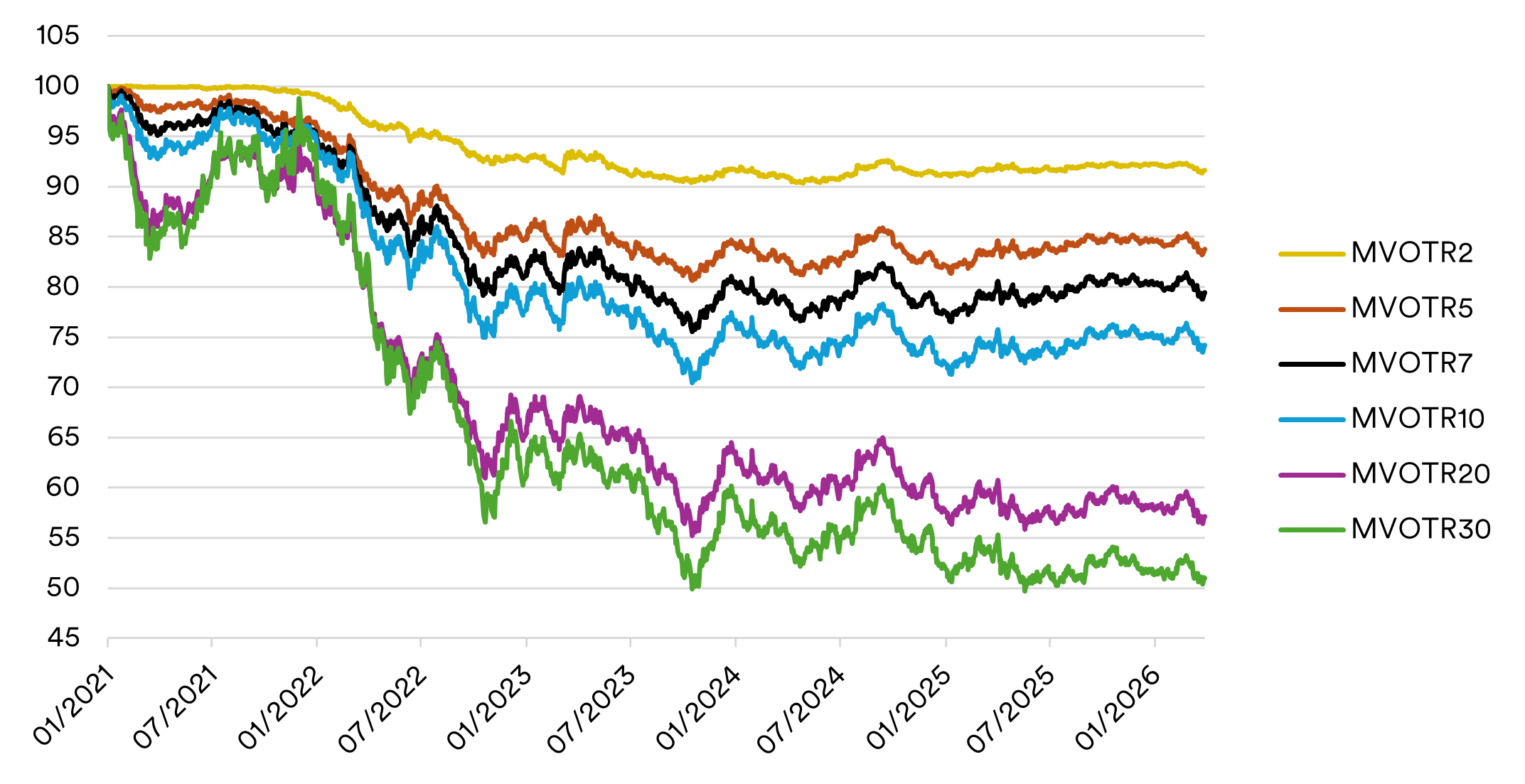
Source: MarketVector™ Indexes, January 2021 – March 2026.
Eliminating Structural Distortions
By construction, the on-the-run methodology removes the key inefficiencies embedded in traditional indexes.
Each index maintains an effectively full allocation to the on-the-run U.S. Treasury security (99.99%), with a minimal residual weight (0.01%) assigned to the previously on-the-run bond solely for operational continuity and index calculation stability3. This residual position has no material impact on performance, duration, or risk characteristics, ensuring that the index remains economically equivalent to a single-CUSIP benchmark.
There is no delivery optionality, as the framework avoids cheapest-to-deliver dynamics and multi-security substitution effects. This is particularly relevant for derivatives, where optionality introduces pricing ambiguity.
There is no artificial duration smoothing. Duration is fully determined by the selected bond, meaning that sensitivity to interest rate movements is transparent, stable, and directly hedgeable.
Finally, rebalancing is not discretionary, but issuance-driven. As new Treasuries are auctioned, the benchmark naturally rolls forward, mirroring Treasury issuance cycles rather than imposing a model-driven schedule.
Implications for Perpetual Futures Markets
Perpetual futures (“perps”) are derivative instruments that provide continuous exposure to an underlying asset without a fixed maturity, using funding rate mechanisms to anchor prices to the reference market. As these products expand into interest rate markets, they require robust, transparent, and continuously tradable benchmarks.
These properties are foundational for derivatives design. Perpetual futures require an underlying reference that is:
- Continuously tradable and highly liquid
- Unambiguous in its definition
- Free from embedded optionality or model-driven distortions
- Directly hedgeable in the underlying cash market
On-the-run U.S. Treasuries uniquely satisfy all of these conditions. By embedding them into a transparent, rules-based index framework, the MarketVector indexes create institutionally robust underlyings for perpetual futures.
Because each index maps one-to-one to a real security, pricing, hedging, and arbitrage relationships remain intact and observable. This enables:
- Reliable mark prices
- Efficient funding rate mechanisms
- Clean basis relationships between cash, futures, and perpetuals
In contrast, basket-based benchmarks introduce ambiguity at every stage of the derivatives stack, from pricing to risk management.
Reframing the Yield Curve as a Tradable System
Taken together, the MarketVector U.S Treasury On-the-Run Indexes family transforms the U.S. Treasury curve from a conceptual construct into a modular, tradable system of benchmark instruments.
Each maturity point, from 2-year through 30-year, becomes:
- A standalone reference rate
- A derivatives-ready underlying
- A building block for curve strategies
This enables precise implementation of:
- Curve steepening and flattening trades
- Cross-maturity relative value strategies
- Funding and basis arbitrage across tenors
In this framework, the objective is not diversification or portfolio representation. It is benchmark fidelity.
Figure 2: Cross-Maturity Correlation Matrix (Daily Log Returns)
|
MVOTR2 |
MVOTR5 |
MVOTR7 |
MVOTR10 |
MVOTR20 |
MVOTR30 |
|---|---|---|---|---|---|---|
MVOTR2 |
1 |
|||||
MVOTR5 |
0.92 |
1 |
||||
MVOTR7 |
0.86 |
0.99 |
1 |
|||
MVOTR10 |
0.79 |
0.95 |
0.98 |
1 |
||
MVOTR20 |
0.63 |
0.83 |
0.90 |
0.96 |
1 |
|
MVOTR30 |
0.56 |
0.77 |
0.85 |
0.92 |
0.99 |
1 |
Source: MarketVector™ U.S. Treasury On-the-Run Indexes, January 2021 – March 2026.
Strategic Perspective
In an environment of elevated rate volatility and evolving market structure, benchmarks must move beyond approximation and align directly with underlying liquidity. On-the-run U.S. Treasuries already fulfill this role in traditional markets. The MarketVector™ index framework formalizes this into a transparent, rules-based approach, establishing a new standard for benchmark construction.
Sources:
- U.S. Department of the Treasury. Treasury Securities Overview.
- Fleming, Michael J. (2002). Are Larger Treasury Issues More Liquid? Federal Reserve Bank of New York.
- MarketVector™. U.S. Treasury On-the-Run Indexes, January 2026.
About the Author(s):
Antonio Fons Palomares is a Senior Index Research Analyst at MarketVector Indexes™ (“MarketVector”). His core responsibilities include index research, design, and development across all asset classes. Antonio is a CAIA Charterholder and a Doctoral Researcher in Quantitative Finance at the International University of Andalusia (UNIA), Spain, where his research focuses on Time Series analysis. He holds a Master of Science in Financial Engineering from the University of Poitiers, France, and a Bachelor’s degree in Economics and Business Administration from the University of Paris-Saclay, France.
For informational and advertising purposes only. The views and opinions expressed are those of the authors but not necessarily those of MarketVector Indexes GmbH. Opinions are current as of the publication date and are subject to change with market conditions. Certain statements contained herein may constitute projections, forecasts, and other forward-looking statements that do not reflect actual results. It is not possible to invest directly in an index. Exposure to an asset class represented by an index is available through investable instruments based on that index. MarketVector Indexes GmbH does not sponsor, endorse, sell, promote, or manage any investment fund or other investment vehicle that is offered by third parties and that seeks to provide an investment return based on the performance of any index. The inclusion of a security within an index is not a recommendation by MarketVector Indexes GmbH to buy, sell, or hold such security, nor is it considered to be investment advice.
Get the latest news & insights from MarketVector
Get the newsletterRelated:
Most popular
-
 Commentary
Goal! Small Country, Big Impact
-
 Commentary
Hidden GEMs: Ukraine