
A historical analysis of 2,286 DCA campaigns initiated during Bitcoin bear markets — what the data actually shows about systematic accumulation versus lump sum investing.

Introduction
Every Bitcoin cycle has a moment when the market falls 50% from its prior all-time high. At that point, investors face a difficult question: is this capitulation or is there further downside ahead? History shows that the first 50% drawdown has rarely marked the final bottom. In several major cycles, Bitcoin declined substantially further after crossing that threshold, leaving early buyers exposed to prolonged volatility and negative returns.
This study examines what actually happens after Bitcoin falls 50%. Using 2,286 historical entry points between 2013 and 2023, we compare two systematic approaches: deploying capital immediately as a lump sum, or accumulating gradually through a 52-week dollar-cost averaging (DCA) strategy. The objective is not to predict bottoms, but to evaluate how different capital deployment methods perform under conditions of extreme uncertainty.
The results reveal a clear pattern: the first 50% decline is not a reliable short-term entry signal for either strategy. However, the way capital is deployed meaningfully affects outcome dispersion, downside risk, and recovery dynamics. Rather than attempting to identify the precise trough, investors may be better served by understanding how time diversification changes the risk profile of entering during deep Bitcoin drawdowns.
Bitcoin’s Drawdown Record: Context
Since 2013, Bitcoin has experienced six distinct bear markets in which the price fell more than 50% from its prior all-time high. These episodes have varied considerably in depth, duration, and macroeconomic context:
Episode |
Trough |
Max DD |
Days to ATH |
2013–2014 Bear Market |
Jan 2015 |
−85% |
778 days |
2014–2016 Consolidation |
Aug 2016 |
−57% |
212 days |
2017–2018 Crypto Winter |
Dec 2018 |
−84% |
716 days |
2020 COVID Crash |
Mar 2020 |
−75% |
263 days |
2021 Mid-Cycle Correction |
Jul 2021 |
−53% |
91 days |
2022 FTX / Rate Hike Collapse |
Nov 2022 |
−77% |
469 days |
Table 1: Bitcoin’s major bear market episodes, 2013–2023. Source: MarketVector Indexes.
Despite the severity of each episode, Bitcoin has ultimately recovered and reached new all-time highs in every completed cycle. The median time to recover a prior all-time high is 366 days. This persistent recovery pattern forms the empirical foundation for the accumulation strategy examined in this paper.
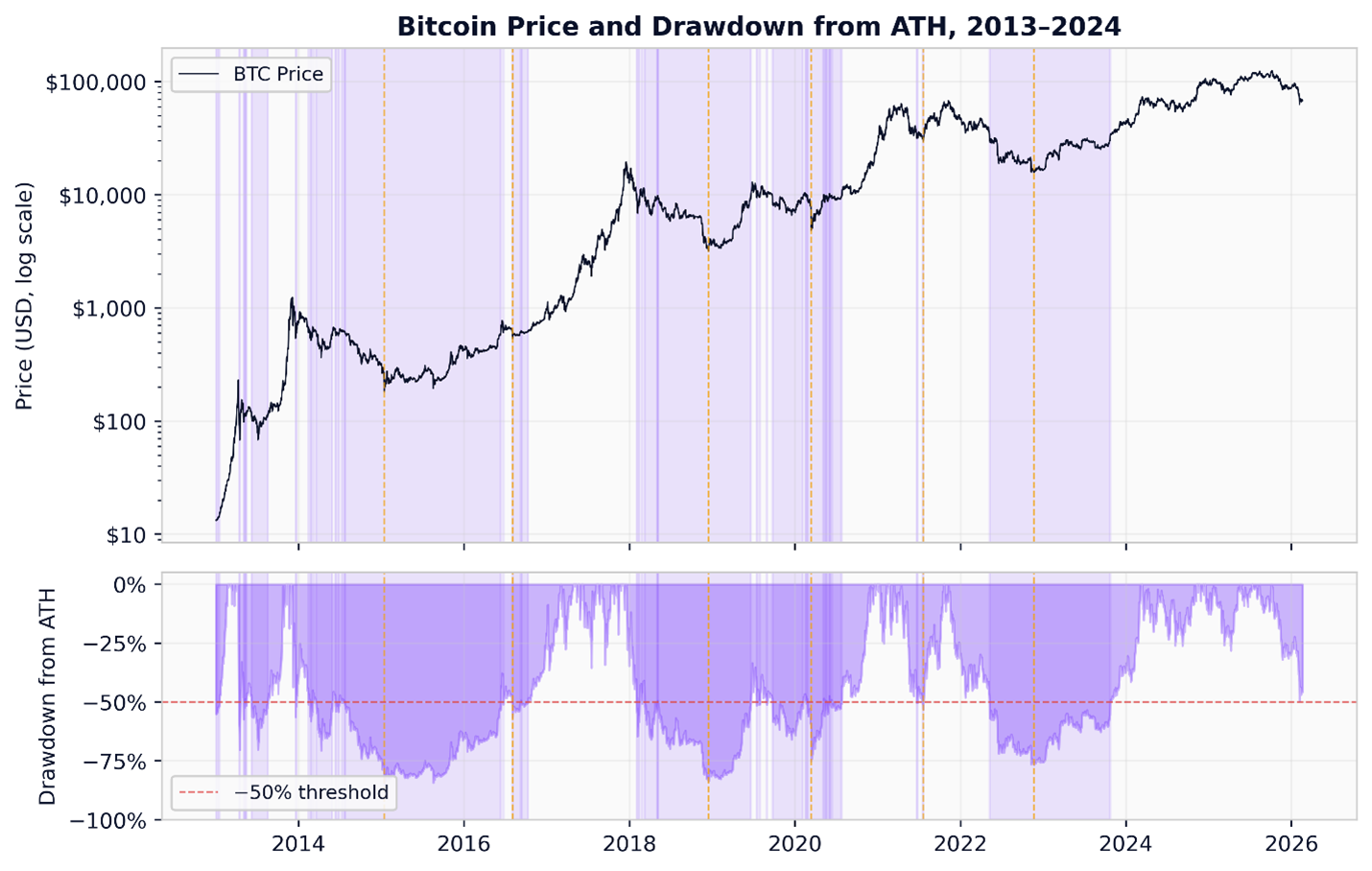
Figure 1: Bitcoin price (log scale) and drawdown, 2013–2024. Purple shading indicates periods with drawdown exceeding 50%; orange dashed lines mark historical troughs. Source: MarketVector Indexes.
The Core Problem: −50% Is Not the Bottom
An intuitive response to a −50% drawdown is to deploy capital as a lump sum — buying the depressed price before the recovery. This sounds compelling in theory but faces a fundamental empirical challenge: the initial −50% threshold has frequently not been anywhere near the actual bottom. In the 2013–2014, 2017–2018, and 2022 bear markets, Bitcoin fell a further 30–65% after first crossing the −50% level. An investor who deployed all capital on that first signal found themselves deep underwater for months or years.
When we test both strategies triggered on the first day each bear market crosses −50%, the results are sobering:
LUMP SUM AT FIRST −50% SIGNAL 20%Win Rate (1Y) | Median: −35% |
DCA STARTING AT FIRST −50% SIGNAL 40%Win Rate (1Y) | Median: −39% |
Neither strategy is a guaranteed winner at the first −50% signal. The market may still have significantly further to fall. However, DCA already shows a structural advantage: it beats lump sum in 3 of 4 losing episodes and delivers a structurally better worst-case outcome. The reason is mechanical: because DCA continues to purchase weekly over 52 weeks, it automatically accumulates additional units if prices fall further, progressively lowering the average cost basis throughout the campaign.
Extending the horizon to two years improves the picture considerably. At the 2-year mark, 3 of the 5 first-cross episodes show positive DCA returns (vs. 2 of 5 at the 1-year mark), and the 2017–2018 episode flips from −44% to +52% as the recovery catches up to the DCA accumulation window. However, the 2013–2014 and 2021 episodes remain negative at both horizons, confirming that the first −50% signal alone does not guarantee a profitable outcome even over longer periods.
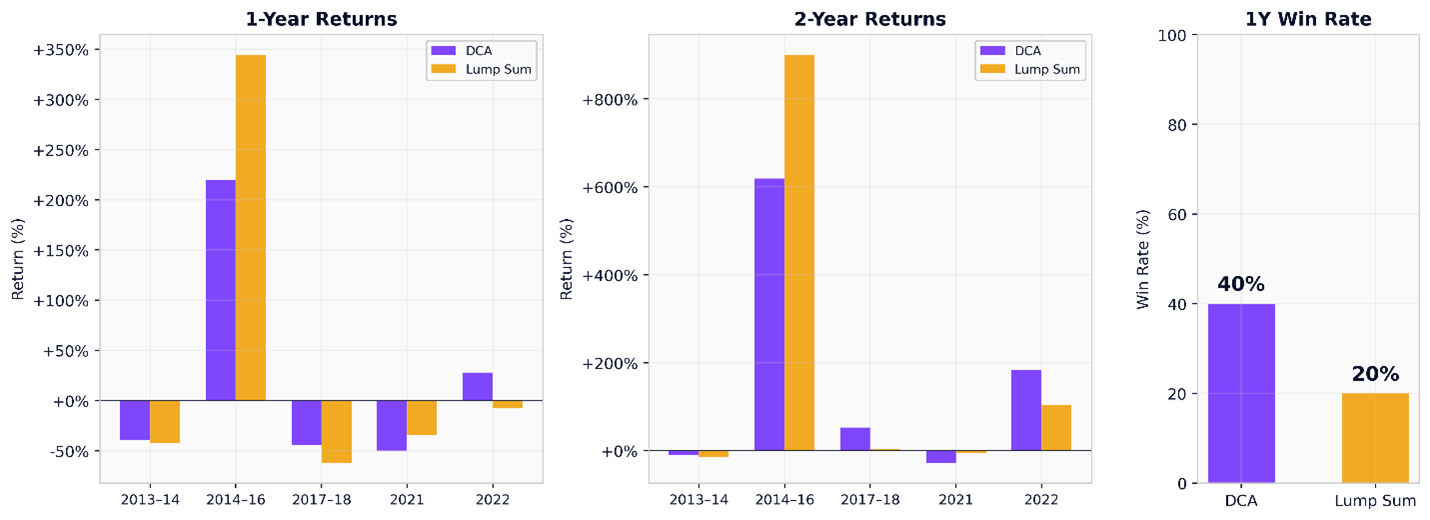
Figure 2: Lump sum vs. DCA performance when both strategies are triggered on the first day Bitcoin crosses −50% from ATH. Left: 1-year returns. Centre: 2-year returns. Right: 1-year win rates. Five first-cross events in the 2013–2023 sample. Source: MarketVector Indexes.
Deeper in the Bear Market: Where the Picture Improves
The negative median return observed at the first −50% signal does not imply that deep drawdowns are unattractive entry points. It reflects something more specific: the first breach of −50% typically occurs early in a bear market, often well before the ultimate trough.
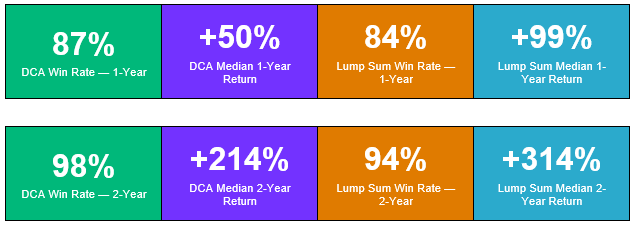
To distinguish between an early signal and the broader drawdown regime, we expand the analysis. Instead of examining only the first day Bitcoin crosses −50%, we include every trading day during which Bitcoin remained 50% or more below its prior all-time high. This produces 2,286 independent entry points across the 2013–2023 sample. Across all eligible days below −50%, where the average entry drawdown was approximately −66%, the median 1-year return becomes strongly positive.
At the 1-year horizon, Bitcoin has already fallen significantly and subsequent returns are strongly positive in most cases. The lump sum median of +99% exceeds the DCA median of +50%, because lump sum concentrates all capital at a single, deeply discounted price and captures the full recovery. DCA, by contrast, continues buying as prices recover during the campaign, which dilutes the average entry price but also provides a buffer against continued declines immediately after deployment.
Extending to the 2-year horizon amplifies this pattern. The DCA win rate rises from 87% to 98%, and the median return climbs from +50% to +214%. Lump sum similarly improves to a 94% win rate and +314% median. The 2-year horizon allows more time for Bitcoin’s cyclical recovery to materialise, converting the remaining 1-year losers - typically campaigns that started early in a prolonged bear market - into winners.
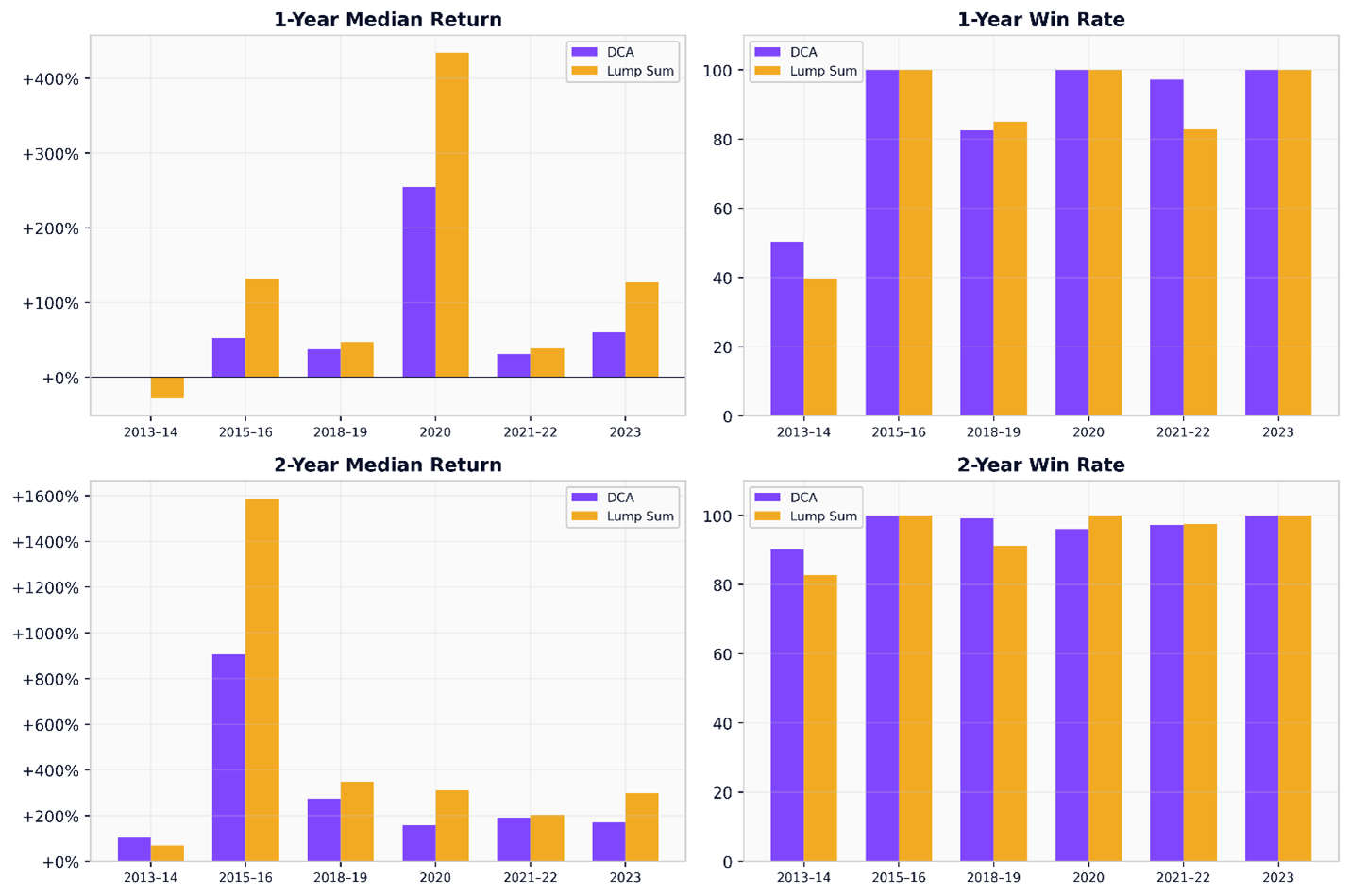
Figure 3: Median return (left) and win rate (right) by bear market episode, at both 1-year (top) and 2-year (bottom) horizons. DCA vs. lump sum across all eligible days within each episode. Source: MarketVector Indexes.
Figure 3 reveals an important pattern: in the initial 2013–2014 bear market — where BTC continued falling for over a year after the first −50% signal — DCA delivered only a marginally positive median 1-year return with a 50% win rate. But at the 2-year mark, even this weakest episode improves to a 90% DCA win rate and +103% median return. The 2021–2022 episode shows DCA’s defensive character clearly: a 97% DCA win rate against an 83% lump sum win rate at 1 year, as DCA investors who started in mid-2022 continued accumulating through the FTX collapse and benefited from the 2023 recovery.
The Structural Edge: DCA’s Variance Reduction
A claim frequently made about DCA that it reduces risk relative to lump sum is sometimes asserted without evidence. Figure 4 makes the case directly. Across all 2,286 campaigns, the standard deviation of DCA 1-year returns is 119%, compared to 516% for lump sum, less than a quarter of the dispersion. The interquartile range (25th–75th percentile) for DCA spans +25% to +87%, while lump sum spans +32% to +161%. The worst DCA outcome (−50%) is materially better than the worst lump sum outcome (−63%). In short, DCA compresses the distribution of outcomes around the median, sacrificing some upside in exchange for substantially less uncertainty about the final result.
The right panel of Figure 4 decomposes this into a risk–return scatter by episode. In every bear market, the DCA dot (circle) sits to the left of its corresponding lump sum dot (square) - lower standard deviation for a given level of median return. The gap is widest in the most volatile episodes (2013–2014, 2020), where lump sum outcomes range from deeply negative to extraordinary gains depending on precise entry timing. DCA narrows this range by mechanically averaging across the price path.
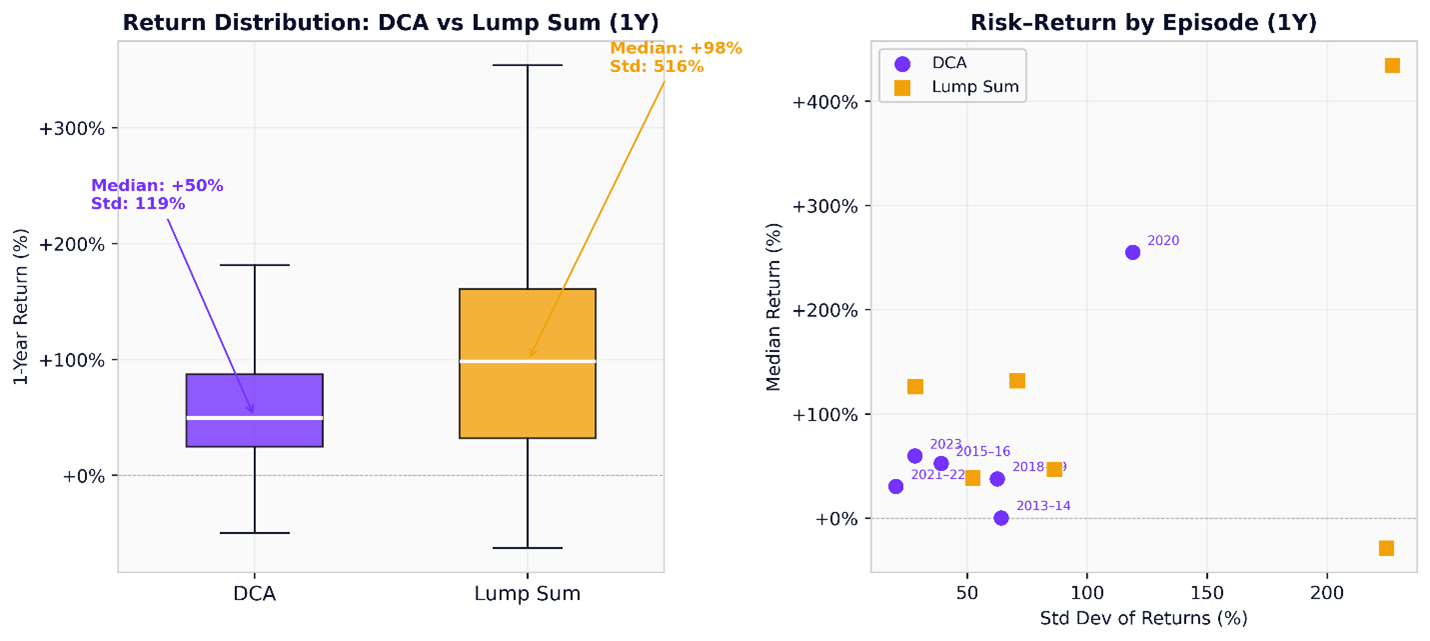
Figure 4: Left: box plots of 1-year return distributions for DCA vs. lump sum across all 2,286 campaigns (whiskers at 5th/95th percentile). Right: risk–return scatter by episode — each pair shows median return vs. standard deviation. DCA consistently clusters at lower volatility. Source: MarketVector Indexes.
Metric |
DCA (1Y) |
Lump Sum (1Y) |
Median return |
+50% |
+99% |
Standard deviation |
119% |
516% |
Interquartile range |
+25% to +87% |
+32% to +161% |
Worst outcome |
−50% |
−63% |
Best outcome |
+1,316% |
+6,783% |
Sharpe-like ratio (median / std) |
0.42 |
0.19 |
Table 2: Risk and return statistics for DCA vs. lump sum, 1-year horizon, all 2,286 campaigns. DCA delivers roughly half the median return at less than one-quarter the volatility. Source: MarketVector Indexes.
How Deep Is Deep Enough? Win Rates by Entry Drawdown
The preceding analysis groups all days below −50% together, but a natural question arises: does the depth of the drawdown at entry materially affect outcomes? Figure 5 breaks the 2,286 campaigns into drawdown buckets and shows how win rates and median returns evolve as the entry point moves deeper into the bear market.
The results are instructive. At the 1-year horizon, the DCA win rate remains above 77% even at the shallowest drawdown bucket (−50% to −55%), and rises steadily to 99% for entries between −80% and −85%. Lump sum follows a similar but steeper curve: its 1-year win rate drops from 100% at −80% to −85% to just 70% at −50% to −55%, reflecting its higher sensitivity to exact entry timing. At the 2-year horizon, both strategies converge toward near-certainty — the DCA 2-year win rate exceeds 92% at every drawdown level, reaching 100% for entries below −70%.
The right panel shows that median returns increase as entry drawdowns deepen, as one would expect — the cheaper you buy, the more you stand to gain. However, the relationship is not monotonic for DCA, because the DCA cost basis reflects the average of all 52 weekly purchase prices rather than the entry price alone. The practical implication is clear: there is no magic drawdown threshold below which DCA suddenly starts working. It works at every level tested, with steadily improving odds as the drawdown deepens.
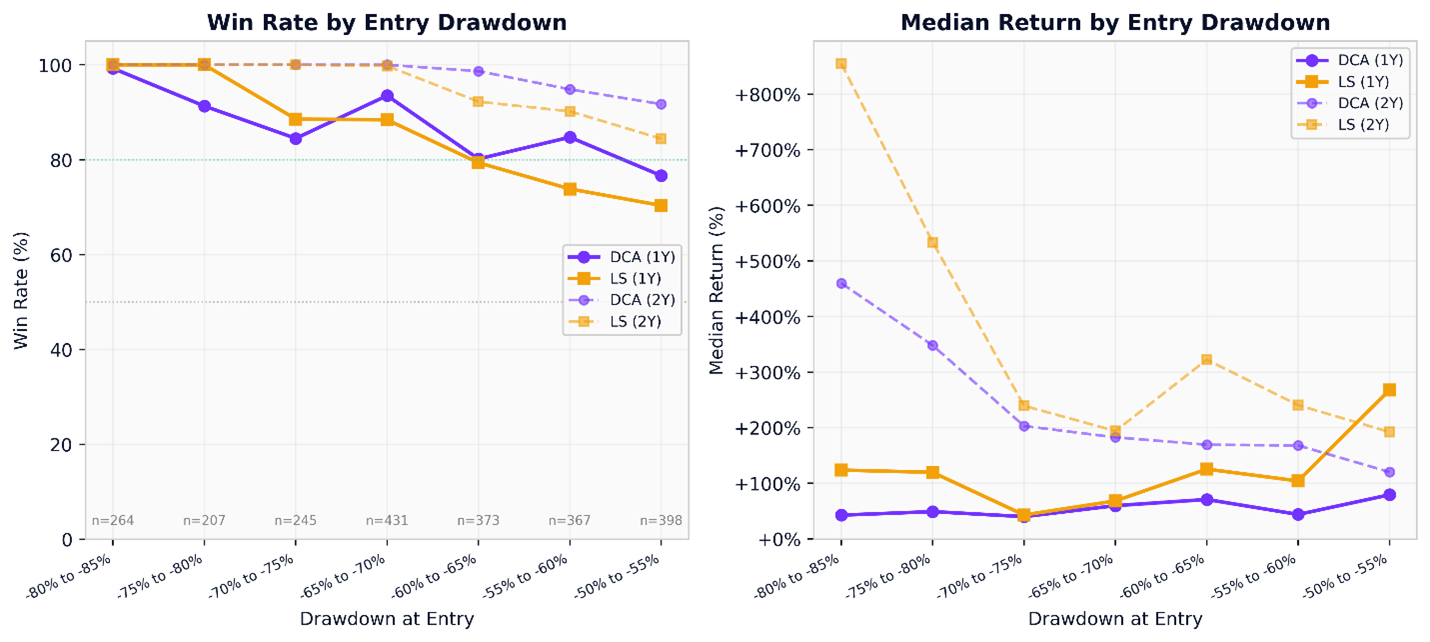
Figure 5: Win rate (left) and median return (right) by drawdown at entry, bucketed in 5-percentage-point intervals. Solid lines = 1-year horizon; dashed lines = 2-year horizon. Sample sizes (n) shown at bottom of left panel. Source: MarketVector Indexes.
Entry Drawdown |
N |
DCA WR (1Y) |
DCA Med (1Y) |
LS WR (1Y) |
LS Med (1Y) |
DCA WR (2Y) |
−80% to −85% |
264 |
99% |
+43% |
100% |
+124% |
100% |
−75% to −80% |
207 |
91% |
+49% |
100% |
+120% |
100% |
−70% to −75% |
245 |
84% |
+40% |
89% |
+43% |
100% |
−65% to −70% |
431 |
94% |
+60% |
88% |
+68% |
100% |
−60% to −65% |
373 |
80% |
+71% |
79% |
+125% |
99% |
−55% to −60% |
367 |
85% |
+44% |
74% |
+104% |
95% |
−50% to −55% |
398 |
77% |
+79% |
70% |
+268% |
92% |
Table 3: Performance by entry drawdown bucket. DCA maintains a 77%+ win rate at all depths; lump sum drops below 80% for entries shallower than −65%. At the 2-year horizon, DCA exceeds 92% at every level. Source: MarketVector Indexes.
Reference: Forward Returns from Historical Troughs
For context, Figure 6 shows the magnitude of recoveries when measured from the actual historical trough - the best possible entry point. These returns are substantially higher than those achievable with any trigger-based strategy, for the simple reason that they require perfect hindsight. No investor can systematically buy at the exact bottom in real time. This is precisely what makes a rules-based DCA approach valuable: it removes the need to identify the trough at all.
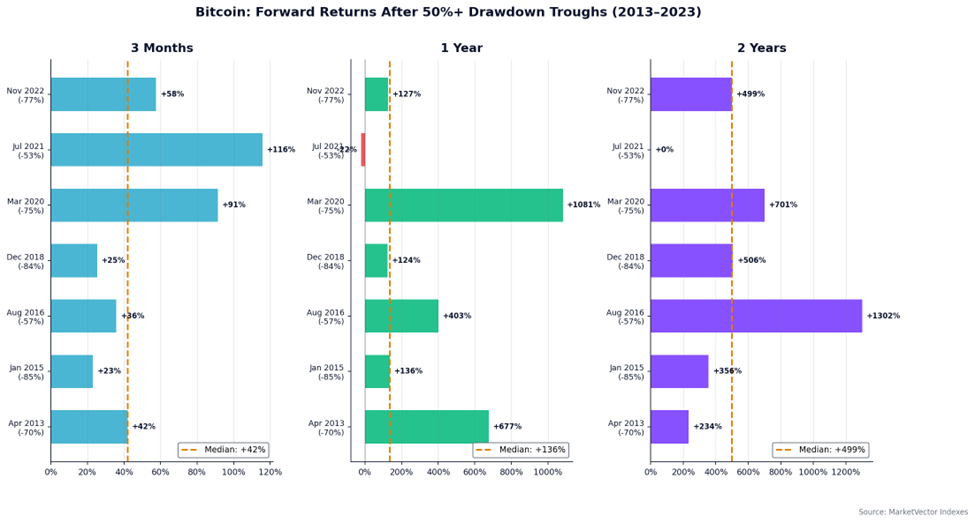
Figure 6: Bitcoin forward returns measured from historical drawdown troughs (3-month, 1-year, 2-year horizons). These figures represent the theoretical maximum achievable with perfect timing — shown as a reference benchmark, not a replicable strategy. Source: MarketVector Indexes.
Methodology
Entry Trigger
An eligible DCA start date is defined as any calendar day on which Bitcoin’s closing price represents a drawdown of 50% or more relative to the rolling maximum (prior all-time high). For the first-cross analysis, we identify five distinct events in the 2013–2023 sample where Bitcoin’s drawdown first crosses the −50% threshold (a new first-cross is triggered whenever Bitcoin recovers above −50% and subsequently re-crosses below it). Within the all-eligible-days analysis, every trading day below −50% is treated as an independent DCA start date. The analysis covers the period January 2013 to December 2023.
DCA Structure
For each eligible start date, we simulate a 52-week DCA campaign: $100 is invested at the weekly closing price, for total deployed capital of $5,200. As a benchmark, we simultaneously simulate a lump sum investment of $5,200 on the same start date, giving both strategies identical entry signals and capital.
Performance Measurement
For DCA, return = (total BTC accumulated × exit price − total capital invested) / total capital invested. For lump sum, return = (exit price − entry price) / entry price. A “win” is defined as a positive return. Returns are measured at both a 1-year and 2-year horizon from the DCA start date. Note that the 1-year evaluation horizon coincides approximately with the end of the 52-week DCA deployment period; the 2-year horizon therefore provides a full additional year of holding after the final DCA purchase.
DCA’s Cost Basis Effect
Because DCA purchases are spread across 52 weekly intervals, the average price paid per Bitcoin reflects the full range of prices experienced during the campaign rather than a single point-in-time entry. In most bear market episodes, Bitcoin recovered substantially during the 12-month DCA window, which means the DCA average cost basis is typically above the day-1 entry price, the median DCA cost basis is approximately 29% higher than the initial entry price. This might seem disadvantageous, but it is precisely the mechanism that gives DCA its lower variance: the cost basis converges toward the median price over the period, reducing the investor’s dependence on any single entry point.
The structural advantage of DCA becomes most apparent in the scenarios where the bear market continues to deepen after entry. In these cases such as the 2013–2014 and early 2018 episodes, DCA does achieve a cost basis below the day-1 price, because the weekly purchases capture progressively lower prices. This is the mechanical reason DCA tends to outperform lump sum in adverse scenarios: the worse the drawdown becomes after entry, the more the DCA cost basis falls relative to the initial lump sum deployment price.
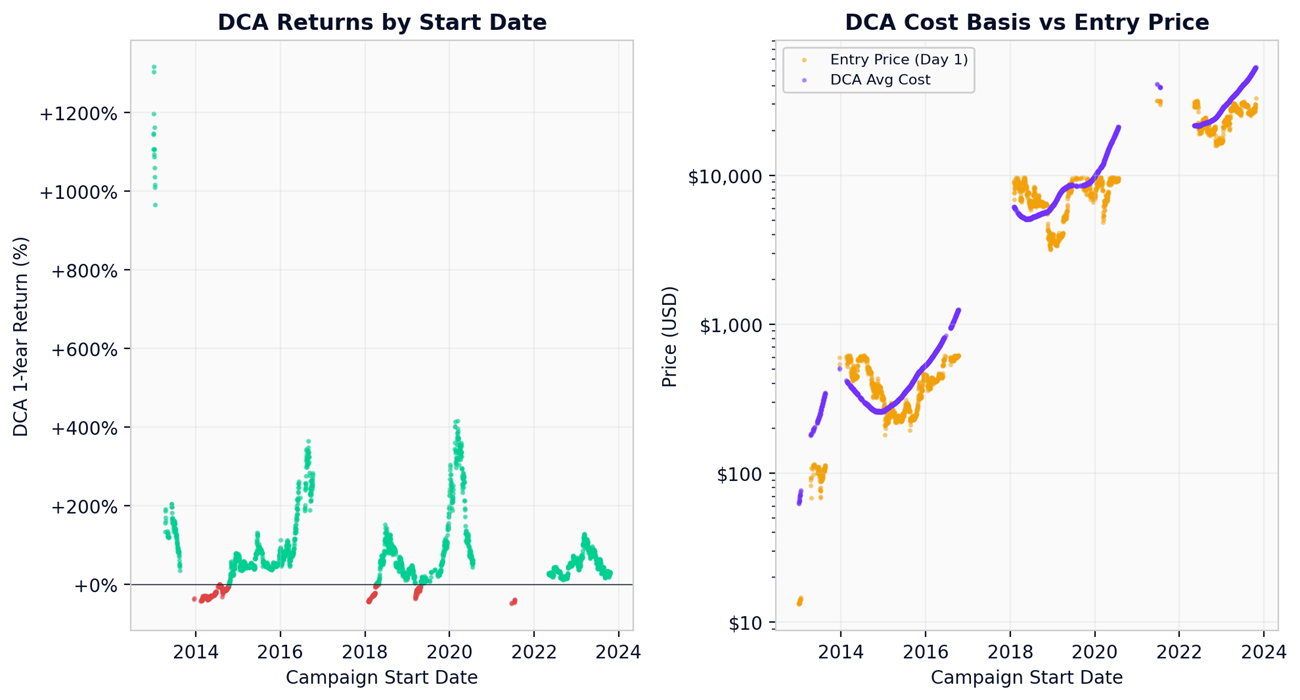
Figure 7: Left: DCA 1-year return by campaign start date, colored by return magnitude (red = negative, green = positive). Right: DCA average cost basis (purple) vs. entry price (orange). The cost basis reflects the time-weighted average of prices across the 52-week deployment window. Source: MarketVector Indexes.
Interpretation and Investment Implications
The analysis yields a nuanced but actionable picture. Three key conclusions emerge:
- The first −50% signal is not a reliable buy trigger for either strategy. Lump sum at the initial −50% threshold has historically produced a positive 1-year return in only 20% of cases (median: −35%). DCA fares better (40% win rate, −39% median) but is not a reliable short-term win at this stage either. Extending to two years improves the picture but does not eliminate the risk. Investors who expect the first −50% signal to mark the bottom will frequently be disappointed.
- DCA’s structural advantage is most pronounced when timing is hardest. At the first −50% signal, DCA outperforms lump sum in 3 of 4 losing episodes and delivers a structurally better worst-case outcome. More importantly, DCA’s return volatility is less than one-quarter that of lump sum (119% vs. 516% standard deviation), giving investors a much narrower range of expected outcomes. Once deeper into the bear market — where the average entry drawdown is −66%, both strategies have historically rewarded patient investors, with DCA delivering an 87% win rate and +50% median 1-year return, rising to 98% and +214% at the 2-year mark.
- The choice between DCA and lump sum is ultimately about risk tolerance, not return maximisation. Lump sum has historically delivered higher median returns (+99% vs. +50% at 1 year, +314% vs. +214% at 2 years) because it captures the full recovery from a single discounted entry. DCA sacrifices some upside in exchange for substantially lower variance and better downside protection. For investors who cannot confidently identify where the bear market stands relative to the eventual trough, DCA offers a disciplined, emotion-free alternative.
It is important to acknowledge the limitations of this analysis. The sample covers six completed bear market episodes - a meaningful dataset by crypto standards, but small in absolute statistical terms. Bitcoin’s market structure, liquidity profile, and institutional participation have changed materially over the sample period, and past recovery patterns cannot be assumed to repeat. Nonetheless, the consistency of results across six distinct macroeconomic environments lends meaningful empirical support to the systematic accumulation approach.
Conclusion
Bear markets are psychologically difficult. The first signal that Bitcoin has fallen 50% from its high is not, on its own, a reliable short-term buy signal — and investors should not expect immediate positive returns from either strategy at that point. However, the DCA approach already shows a structural advantage at this hardest moment: higher win rate, better median outcome, and significantly reduced downside compared to immediate full deployment.
As the bear market deepens and Bitcoin trades further below its all-time high, the historical evidence becomes increasingly compelling. A systematic weekly accumulation strategy has delivered positive returns in 87% of cases at 1 year and 98% at 2 years across the 2013–2023 period — with less than one-quarter the return volatility of lump sum. The data suggest that deep bear markets are not necessarily a reason for alarm but they do reward a disciplined, rules-based approach over emotional timing decisions.
DISCLAIMER
This document is provided for informational and educational purposes only and does not constitute investment advice, a solicitation, or an offer to buy or sell any financial instrument. Past performance is not indicative of future results. All investments involve risk, including the possible loss of principal. Digital assets are highly volatile and speculative in nature. MarketVector Indexes GmbH does not provide investment advice. The analysis is based on historical data from the MarketVector Bitcoin Index (MVBTC) and is subject to the limitations inherent in any retrospective analysis. Simulated or hypothetical performance results have certain inherent limitations. Readers should seek independent financial advice before making investment decisions.
About the Author(s):
Martin Leinweber leads digital asset research and strategy at MarketVector Indexes, where he develops index products, publishes institutional research, and serves as the firm's primary voice on crypto markets to a global client base. His work sits at the intersection of systematic investing and an emerging asset class, translating rigorous quantitative frameworks into actionable insight for institutional investors. Before joining MarketVector, Martin spent nearly two decades as a Portfolio Manager across equities, fixed income, and alternative investments. At Quoniam Asset Management, one of Germany's foremost quantitative houses, he managed active funds for institutional clients including insurance companies, pension funds, and sovereign wealth funds. Earlier in his career at MEAG, the asset manager of Munich Re and ERGO, he contributed to the firm's international expansion, including the establishment of a joint venture with PICC, China's largest insurance company, with operations in Shanghai and Beijing. Martin is co-author of two Wiley publications: Asset-Allokation mit Kryptoassets: Das Handbuch (2021), the first institutional handbook on integrating digital assets into traditional portfolios, and Mastering Crypto Assets: Investing in Bitcoin, Ethereum, and Beyond (2024). He holds a Master of Economics from the University of Hohenheim and is a CFA Charterholder.
IMPORTANT DEFINITIONS AND DISCLOSURES
Copyright © 2026 by MarketVector Indexes GmbH (‘MarketVector’) All rights reserved. The MarketVector family of indexes (MarketVectorTM, Bluestar®, MVIS®) is protected through various intellectual property rights and unfair competition and misappropriation laws. MVIS® is a registered trademark of Van Eck Associates Corporation that has been licensed to MarketVector. MarketVectorTM and MarketVector IndexesTM are pending trademarks of Van Eck Associates Corporation. BlueStar®, BlueStar Indexes®, BIGI®, and BIGITech® are trademarks of MarketVector Indexes GmbH.
Redistribution, reproduction, and/or photocopying in whole or in part are prohibited without written permission. All information provided by MarketVector is impersonal and not tailored to the needs of any person, entity, or group of persons. MarketVector receives compensation in connection with licensing its indexes to third parties. You require a license from MarketVector to launch any product that is linked to a MarketVectorTM Index to use the index data for any business purpose and all use of the MarketVectorTM name or name of the MarketVectorTM Index. The past performance of an index is not a guarantee of future results.
It is not possible to invest directly in an index. Exposure to an asset class represented by an index is available through investable instruments based on that index. MarketVector does not sponsor, endorse, sell, promote, or manage any investment fund or other investment vehicle that is offered by third parties and that seeks to provide an investment return based on the performance of any index. MarketVector makes no assurance that investment products based on the index will accurately track index performance or provide positive investment returns. MarketVector is not an investment advisor, and it makes no representation regarding the advisability of investing in any such investment fund or other investment vehicle. A decision to invest in any such investment fund or other investment vehicle should not be made in reliance on any of the statements set forth in this document.
Investments into cryptocurrencies and/or digital assets are subject to material and high risk including the risk of total loss. The calculated prices may not be achieved by investors as the calculated price is based on prices from different trading platforms. Furthermore, an investment into cryptocurrencies and/or digital assets may become illiquid depending on the trading platform or investment product used for the specific investment. Investors should carefully review all risk factors disclosed by the relevant trading platform or in the product documents of relevant investment products.
Prospective investors are advised to make an investment in any such fund or other vehicle only after carefully considering the risks associated with investing in such funds, as detailed in an offering memorandum or similar document that is prepared by or on behalf of the issuer of the investment fund or other vehicle. The inclusion of a security within an index is not a recommendation by MarketVector to buy, sell, or hold such security, nor is it considered to be investment advice.
All information shown prior to the index launch date is simulated performance data created from backtesting ("Simulated past performance”). Simulated past performance is not actual but hypothetical performance based on the same or fundamentally the same methodology that was in effect when the index was launched. Simulated past performance may materially differ from the actual performance. Actual or simulated past performance is no guarantee for future results.
These materials have been prepared solely for informational purposes based upon information generally available to the public from sources believed to be reliable. No content contained in these materials (including index data, ratings, credit-related analyses and data, model, software, or other application or output therefrom) or any part thereof (Content) may be modified, reverse-engineered, reproduced or distributed in any form by any means, or stored in a database or retrieval system, without the prior written permission of MarketVector. The Content shall not be used for any unlawful or unauthorized purposes. MarketVector and its third-party data providers and licensors (collectively “MarketVector Parties”) do not guarantee the accuracy, completeness, timeliness, or availability of the Content. MarketVector Parties are not responsible for any errors or omissions, regardless of the cause, for the results obtained from the use of the Content. THE CONTENT IS PROVIDED ON AN “AS IS” BASIS. MARKETVECTOR PARTIES DISCLAIM ANY AND ALL EXPRESS OR IMPLIED WARRANTIES, INCLUDING, BUT NOT LIMITED TO, ANY WARRANTIES OF MERCHANTABILITY OR FITNESS FOR A PARTICULAR PURPOSE OR USE, FREEDOM FROM BUGS, SOFTWARE ERRORS, OR DEFECTS, THAT THE CONTENT’S FUNCTIONING WILL BE UNINTERRUPTED OR THAT THE CONTENT WILL OPERATE WITH ANY SOFTWARE OR HARDWARE CONFIGURATION. In no event shall MarketVector Parties be liable to any party for any direct, indirect, incidental, exemplary, compensatory, punitive, special, or consequential damages, costs, expenses, legal fees, or losses (including, without limitation, lost income or lost profits and opportunity costs) in connection with any use of the Content even if advised of the possibility of such damages.
Get the latest news & insights from MarketVector
Get the newsletterRelated: